Planning permission is the step people most often expect to hold a heat pump up, and the one that most often turns out not to apply. In England, the rules that let small works go ahead without an application, known as permitted development, include air source heat pumps on homes. The rules were widened in 2025. What matters is meeting every condition, because failing one is enough to need an application.
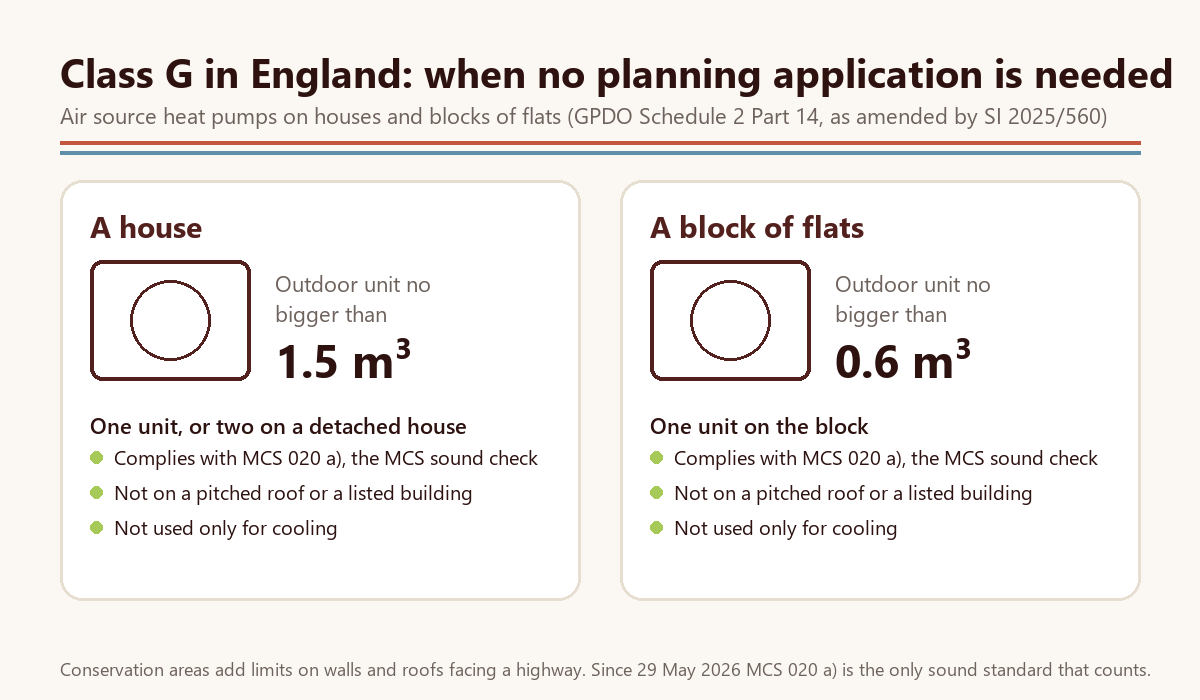
The Class G conditions
The rules sit in Class G of Part 14 of Schedule 2 to the General Permitted Development Order 2015, as changed by SI 2025/560, which took effect on 29 May 2025. An air source heat pump on a house or a block of flats, or in its grounds, is permitted development only if all of these hold:
- The outdoor unit is no more than 1.5 m³ on a house, or 0.6 m³ on a block of flats.
- There is one air source heat pump on a house that is not detached, or on a block of flats; a detached house may have two.
- It complies with MCS 020 a), the MCS sound calculation for permitted development installations.
- It is not on a pitched roof, and not within 1 metre of the outside edge of a flat roof.
- It is not on a listed building or within its grounds, and not on a scheduled monument.
- It is not used only for cooling.
- It is sited to keep its effect on the look of the building and the area, and on neighbours, as small as practical, and removed when no longer needed.
The volume limit applies to the outdoor unit itself. Ask the installer to confirm the volume of the model they quote, since it is their design that has to meet the condition.
MCS 020 a), the sound check
The sound condition is the one that most often decides where a unit can go. MCS 020 a) is a calculation, not a measurement after the event: the installer uses the model's sound figures and the distance to the nearest neighbouring windows to show the unit stays under the limit. MCS has said its simplified calculation works to an overall limit of 37 dB(A). Because distance and screening feed into it, a different position on the same house can give a different answer.
Before 29 May 2025, the rules accepted MCS standards "or equivalent standards". That wording was removed, with a transition for installations already permitted that ended on 28 May 2026. Since 29 May 2026, only MCS 020 a) counts. Ask your installer for the calculation for your site and keep it with your handover papers.
Where on the house it can go
Away from protected areas, the main location rule concerns walls that face a road: a unit on a wall fronting a highway must not be above ground-floor level. On the ground, at the side or rear of a house, or low on a wall, is where most units end up. The guide to where the outdoor unit can go goes through practical siting: access for servicing, the pipe run and where water drains.
Conservation areas, World Heritage Sites and listed buildings
In a conservation area or a World Heritage Site, the unit must not be on a wall or roof that faces a highway, and must not be nearer to a highway than the part of the house closest to it. A rear wall or a back garden can still qualify.
Listed buildings are different: a unit on a listed building, or anywhere within its grounds, is not permitted development at all, and listed building consent may be needed as well as planning permission. If you are not sure whether your home is listed or in a conservation area, the council's planning team can tell you, and national planning data lists both.
Blocks of flats
A block of flats is allowed one air source heat pump under Class G, and its outdoor unit can be no more than 0.6 m³, smaller than the limit for a house. In practice that means a unit for one flat in a block can use the permitted development route only if no other unit is already on the block. Beyond that, a planning application is the route, and the freeholder's permission is a separate question.
Ground source and water source
Ground source heat pumps fall under Class C of the same Part, and water source heat pumps under Class D: installing, altering or replacing one within the grounds of a house or block of flats is permitted development. The Part 14 text sets no size or number limits for these classes. The ground works still need care around trees, drains and services, which is a design matter rather than a planning one. See ground source installation.
When you do need to apply
If any condition fails, the unit can still go in, but it needs planning permission from the council first. Common reasons are a second unit on a semi or terrace, a unit larger than the limit, a site on a road-facing wall in a conservation area, or a listed building. An application takes time, so it belongs in the design stage, before the grant voucher's clock starts. The installation stages page shows where it fits.
These rules are for England. Wales updated its own permitted development rules for heat pumps from 1 June 2026: see the Welsh Government's guidance. Scotland and Northern Ireland have their own systems too.