Across every grant-funded heat pump paid for between May 2022 and September 2026, DESNZ records that 55% replaced mains gas heating, far more than any other fuel. So the most common heat pump installation in England and Wales is a gas boiler coming out. Knowing what that swap involves makes the quotes easier to read.
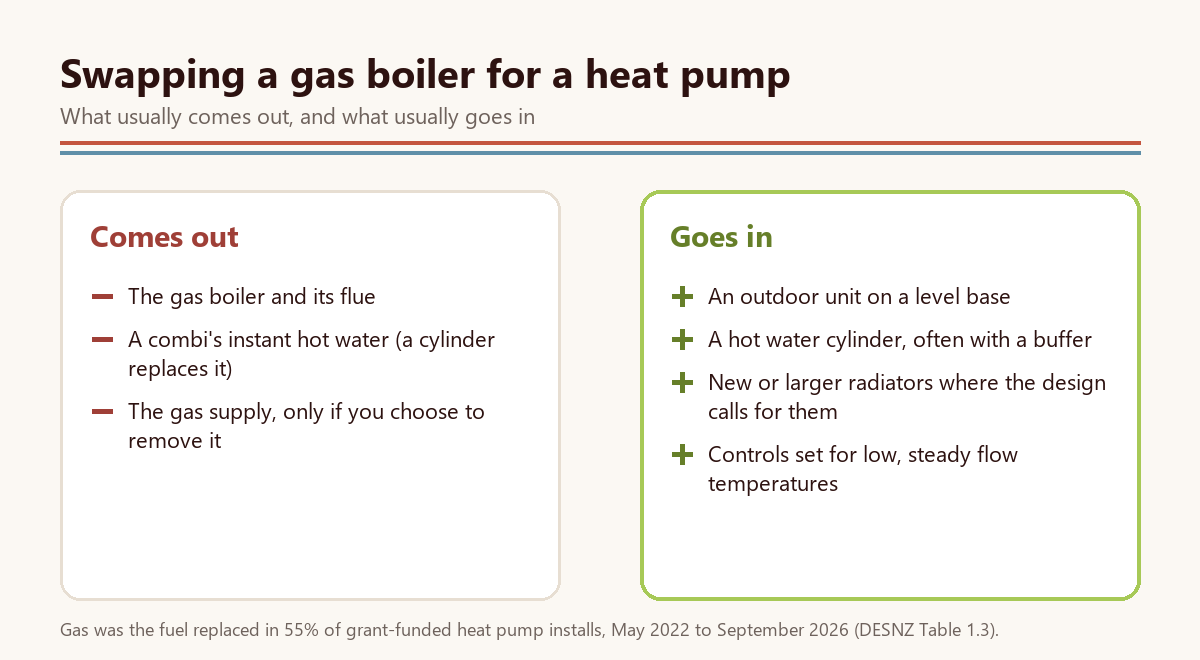
What comes out
The boiler and its flue are removed, and the wall where the flue went through is made good. The boiler's controls are replaced by the heat pump's. If you had a combi, its job of heating water on demand ends, because a heat pump heats a stored cylinder instead. The pipes that fed the boiler with gas are disconnected from it; what happens to the gas supply after that is a separate question, covered below.
What goes in
- An outdoor unit, on a base or brackets, sited to meet the planning conditions in England and the MCS 020 a) sound check.
- A hot water cylinder if there was not one, sized and placed by the design. A buffer tank may be added where the design calls for it.
- Radiator changes in the rooms where the existing radiator cannot heat the room at the heat pump's lower flow temperature.
- New controls, set up at commissioning.
- An electrical supply to the unit, with the network operator told or asked first.
The radiators already connected to the gas boiler usually stay in the system: a heat pump uses the same kind of wet heating circuit. The question is only whether each one is big enough, which the heat-loss survey answers room by room.
Life without a combi
The biggest day-to-day change for many gas homes is hot water. A combi boiler heats water as it flows; a heat pump fills a cylinder in advance, on a schedule. The practical consequences are space for the cylinder, and a store of hot water that can run down with heavy use, so the cylinder's size is worth discussing in terms of how your household uses hot water. Ask the installer how the cylinder size was chosen.
The gas supply
Removing a gas boiler does not remove your gas supply. If the boiler was the only gas appliance, you can keep the supply, have it capped or have the meter and supply removed. Each option has different consequences:
- Keeping it means you keep paying the gas standing charge on your tariff. At the Ofgem price cap for October to December 2026 that is 29.68p a day for gas.
- Capping or removing it is arranged through your gas supplier and the gas network, not your heat pump installer, and may carry a charge. Ask them before you decide.
If you have a gas hob or fire, the supply stays for those anyway. Note that for the grant, a capped gas meter still counts as a mains gas connection, which matters only for the higher oil and LPG rate.
The money
For a gas home, the grant is £7,500 for an air source or ground source heat pump, as long as you own the property, an MCS certified installer applies, and the heat pump replaces the boiler rather than working alongside it. The official median price for an air source installation in July to September 2026 was £12,826, leaving about £5,326 at the median after the grant. Your own figure depends on the size the survey calls for and the radiator and cylinder work. The cost planner shows the median for each size and the dates your job would need to meet.
Running costs after the swap depend on your electricity tariff, how efficiently the system is designed to run, and whether you keep paying a gas standing charge, so they are not something an installation quote can promise. What you can ask for is the design flow temperature and the heat-loss figures, which decide the efficiency the system is set up for.