Fitting a heat pump is less like swapping a boiler and more like a small building project. It has a design stage, an approval stage and a hand-back, and if the grant is involved, it runs against a clock. Knowing the order lets you spot when something is being skipped.
Stage 1: the survey
Everything starts with someone measuring the house. A proper survey works out how much heat each room loses on a cold day: through walls, windows, roof and floor, and through draughts. Those room figures add up to the heat the whole house needs, which sets the size of the heat pump. Installers certified by MCS design to the MCS heat pump design standard, MIS 3005-D.
The visit is also when the installer looks at where the outdoor unit could go, where a cylinder would fit, how the pipes would run, and what the electricity supply looks like. A quote produced without a visit, or without heat-loss figures, is a guess. Our heat-loss survey page covers what to expect from it.
Stage 2: design, quote and the grant application
The survey becomes a design: the unit's size in kilowatts, the design flow temperature, which radiators stay and which grow, the size and position of the cylinder, and the controls. The quote should be built from that design and list each part, with the grant shown as a deduction. Ofgem expects the quote to be clear and itemised.
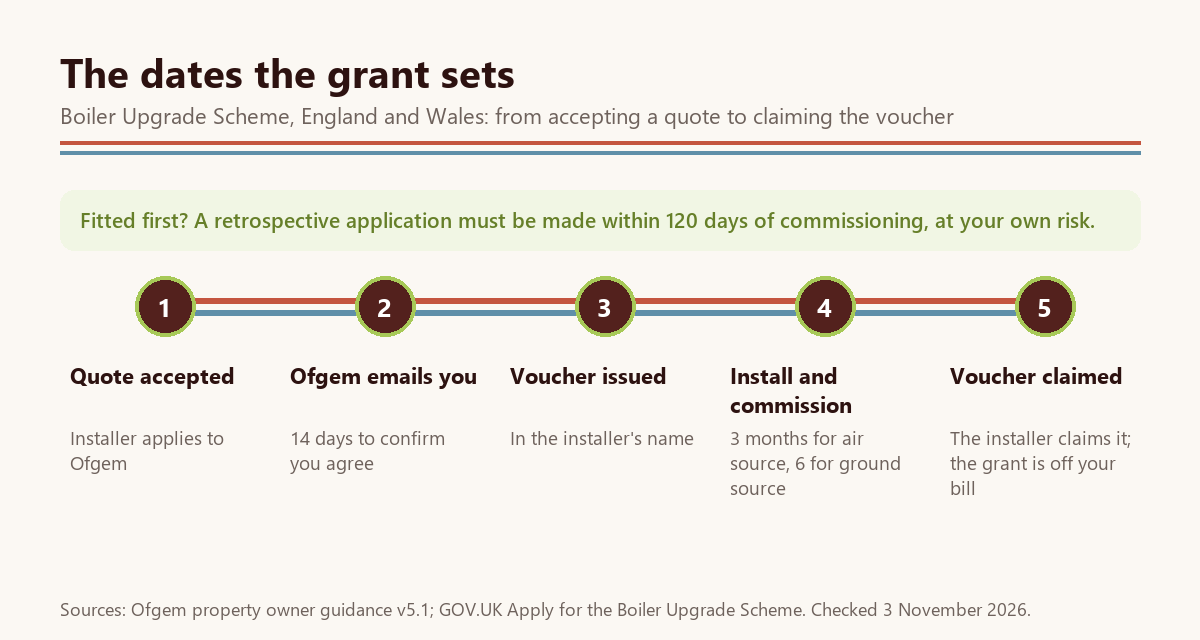
When you accept, the installer applies for the grant on Ofgem's system. Ofgem then emails the property owner to check that the installer is acting for them. You have 14 days to confirm, and if you do not, the application can be rejected. Ofgem may also phone or visit, and MCS may run its own checks.
If the outdoor unit cannot meet every permitted development condition, this is also the stage for a planning application: for example a unit bigger than 1.5 m³, a second unit on a semi-detached house, or a site on a wall facing a road in a conservation area. The planning permission page lists every condition.
Stage 3: the fitting
Once Ofgem issues the voucher in the installer's name, the clock starts: 3 months to install, commission and claim it for an air source heat pump, 6 months for ground source. Inside that window, the fitting usually covers:
- The outdoor unit on a solid base or wall brackets, in the spot the design and the sound check allow, with room left around it for air and servicing.
- The pipe run from the unit through the wall to the heating circuit, insulated outside.
- The cylinder, and a buffer tank where the design needs one, usually in an airing cupboard, loft or utility space.
- The radiators the design says must change, and new controls.
- The electrics: a supply to the unit, and the network operator either notified afterwards or asked first, depending on the home's new maximum demand.
- The old boiler taken out, with whatever it leaves behind made safe.
For ground source, the ground works come first: trenches for a horizontal loop or a drilling rig for boreholes. That is the main reason the voucher allows longer. See ground source installation.
The heating and hot water will be off for part of the fitting. Ask for the days in writing before work starts, especially in winter.
Stage 4: commissioning and the claim
Commissioning is the switch-on done properly: the system filled and checked, the controls set up, readings recorded. The installer then registers the installation with MCS, which produces the MCS certificate, and claims the voucher from Ofgem. The grant is already off your bill at that point; the claim is between the installer and Ofgem.
Before the final payment you should be handed the paperwork: the MCS certificate, the commissioning record, the design figures, building regulations paperwork and warranties. The commissioning and handover page lists each one and why it matters later.
What can push the dates back
Three things regularly add time, and each is easier to plan for than to discover halfway through:
- A planning application. Needed when any permitted development condition fails. It belongs before the fitting, so build it into the schedule.
- The electricity supply. Where the home's new maximum demand is between 60A to 100A, the installer must apply to the network operator before fitting, and the operator assesses it within 10 working days. If the supply needs upgrading, that is extra time and possibly cost. See heat pump electrics.
- Ground works. For ground source, access for diggers or a drilling rig, and the weather, set the pace.
None of these extend the voucher. If a delay looks likely, raise it with the installer early: a voucher that lapses cannot be claimed.
Fitting before applying
Some installations go ahead before a grant is applied for, for example after a breakdown in winter. The scheme allows a retrospective application, but it must be properly made within 120 days of commissioning, and Ofgem's guidance warns that the owner carries extra risk: if the application fails, there is no grant. Only the installer can ask Ofgem to review a decision, within 28 days.
If you are weighing this up, ask the installer in writing what they will charge if the grant is refused. For the amounts and who qualifies, see the cost page, which states the grant of £7,500 with its conditions.