Most of a heat pump installation is plumbing. The electrical side is smaller but has one step that is easy to forget: telling the company that runs your local electricity network. It is the installer's job, but knowing how it works helps you see whether it has been done and whether it could hold up your timetable.
Why the network operator has to know
Your electricity supplier sends the bills; the network operator, often called the DNO, runs the cables and substations that bring power to your street. A heat pump adds a sizeable load that runs for long periods. Network operators need to know where these are being added, and in some cases to check that the local supply can carry the extra demand before it is connected. MCS tells installers that the relevant network operator must be informed each time a heat pump is installed.
The two routes
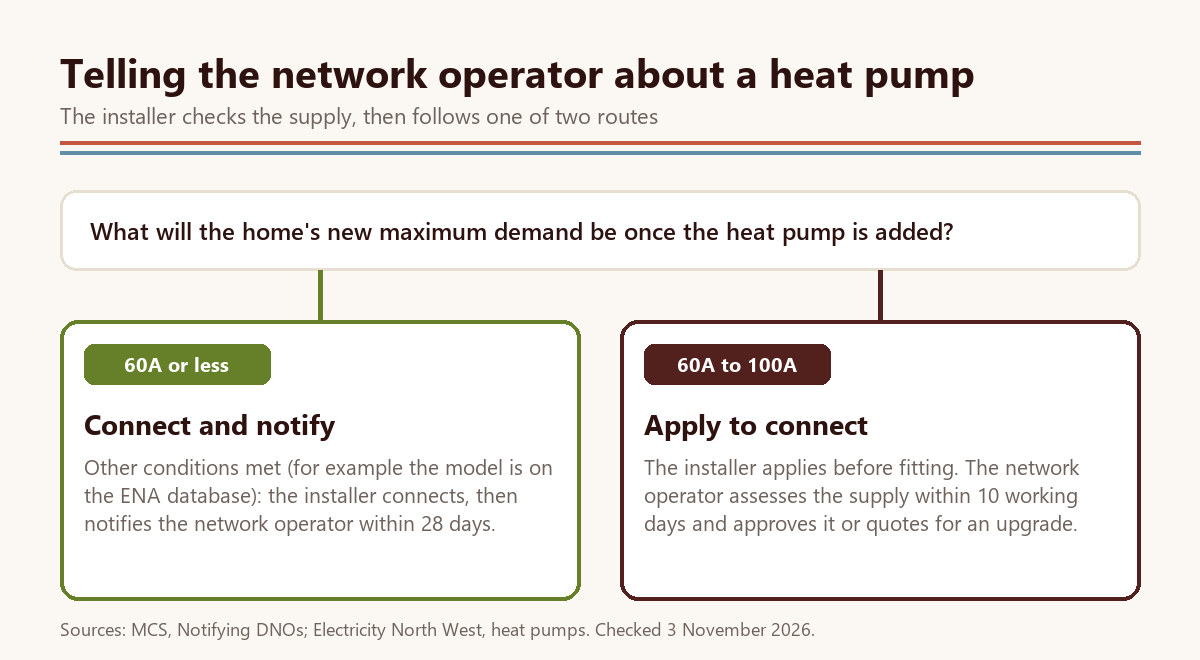
The installer looks at the home's new maximum demand: the most electricity it could draw at once with the heat pump added. MCS describes two routes:
- Connect and notify. Where the new maximum demand is 60A or less and the other requirements are met, the installer can connect the heat pump and then notify the network operator within 28 days of installation.
- Apply to connect. Where the new maximum demand is between 60A to 100A, the installer must apply before installing. The network operator assesses the supply capacity within 10 working days.
Network operators add their own screening. Electricity North West, which serves the North West of England, asks whether the heat pump model is on the Energy Networks Association's register and treats a heat pump with an input above 32 amps (7.36 kW) as needing an application. The same Energy Networks Association form is used for both routes, though a network operator may ask for a different one.
When the supply needs work
If an application shows the supply cannot take the extra load, the network operator either approves the connection or quotes for an upgrade. Electricity North West says most domestic customers face no connection charge, but larger heat pumps may need a supply upgrade that could cost money. It gives an average of £5,370 for one upgrade route, moving a home from a single-phase to a three-phase supply. An upgrade also takes time, so it needs to be known before the grant voucher's clock starts. The installation stages page shows where this sits.
Inside the house
The heat pump needs its own circuit from the consumer unit, and the work has to meet the wiring regulations. Electrical work in homes is another area where installers can self-certify through a competent person scheme; GOV.UK lists the schemes authorised for it. If the consumer unit is old or full, it may need changing, which should appear as a line on the quote rather than a surprise.
What to ask the installer
- Which route applies to your home, and why?
- If an application is needed, when will it go in, and does the schedule allow for the assessment?
- Is any upgrade to the supply or the consumer unit likely, and who pays for it?
- Will you send me a copy of the notification or the approval?
Keep the network operator's reply with the rest of your handover papers. The cost page lists everything else a full quote should cover.